#include <srmhd.h>
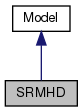
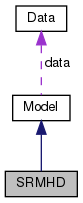
Public Member Functions | |
| SRMHD () | |
| SRMHD (Data *data) | |
| virtual | ~SRMHD () |
| void | sourceTermSingleCell (double *cons, double *prims, double *aux, double *source, int i=-1, int j=-1, int k=-1) |
| void | sourceTerm (double *cons, double *prims, double *aux, double *source) |
| void | getPrimitiveVarsSingleCell (double *cons, double *prims, double *aux, int i=-1, int j=-1, int k=-1) |
| void | getPrimitiveVars (double *cons, double *prims, double *aux) |
| void | primsToAll (double *cons, double *prims, double *aux) |
| void | fluxVector (double *cons, double *prims, double *aux, double *f, const int dir) |
| void | finalise (double *cons, double *prims, double *aux) |
 Public Member Functions inherited from Model Public Member Functions inherited from Model | |
| Model () | |
| Model (Data *data) | |
| virtual | ~Model () |
Public Attributes | |
| int | smartGuesses |
| double * | solution |
| Public Attributes inherited from Model | |
| Data * | data |
| int | Ncons |
| int | Nprims |
| int | Naux |
Detailed Description
Special Relativistic MagnetHydroDynamics
- The single fluid, special relativistic, ideal limit of the MHD equations. Ideal fluid, so resistivity does not play a part, hence no electric field evolution.
- Note
- Model has nine conserved variables:
\(\ \ \ D\), \(S_x\), \(S_y\), \(S_z\), \(\tau\), \(B_x\), \(B_y\), \(B_z\), \(\phi\)
Eight primitive variables:
\(\ \ \ \rho\), \(v_x\), \(v_y\), \(v_z\), \(p\), \(B_x\), \(B_y\), \(B_z\)
Thirteen auxiliary variables:
\(\ \ \ h\), \(W\), \(e\), \(c\), \(b_0\), \(b_x\), \(b_y\), \(b_z\), \(b^2\), \(v^2\), \(B \cdot S\), \(B^2\), \(S^2\)
- The SRMHD fluid equations are derived from the consideration of the conservation of the rest-mass and stress-energy tensor, and the conservation of the Maxwell dual tensor for a perfect magneto-fluid. That is, starting from
\begin{align} \partial_\mu N^\mu &= 0 \\ \partial_mu T^{\mu \nu}&= 0 \\ \partial_mu {^*}F^{\mu \nu} &= 0 \end{align}
with \(N^\mu = \rho u^mu\) the rest-mass density, \(T^{\mu \nu} = \rho h^* u^\mu u^\nu + \eta^{\mu \nu} p^* - b^mu b^nu\) as the stress-energy tensor for a perfect magneto-fluid, and the Maxwell tensor given by \( {^*}F^{\mu \nu} = u^\mu b^\nu - u^\nu b^\mu\).
- In addition, \( u^\mu, h^*=1+e+p/\rho+b^2/\rho, \rho, \eta, b^\mu \text{ and } p*=p+b^2/2\) are the fluid four-velocity, specific enthalpy including the magnetic contribution, mass-energy density, mostly positive flat space-time metric, four-vector magnetic field in the fluid rest-frame and the total pressure including the magnetic pressure.
- Following this through, we arrive at the conservative form of the special relativistic, ideal limit, single fluid equations of motion:
\begin{align} \partial_t \begin{pmatrix} D \\ S^j \\ \tau \\ B^k \\ \phi \end{pmatrix} + \partial_i \begin{pmatrix} Dv^i \\ S^j v^i + p^* \delta^{ij} - b^j B^i / W \\ \tau v^i + p^* v^i - b^0 B^i/ W \\ v^i B^k - v^k B^i + \delta^{ij}\phi \\ B^i \end{pmatrix} = \begin{pmatrix} 0 \\ 0 \\ 0 \\ 0 \\ -\phi / c_p^2 \end{pmatrix}. \end{align}
- Here, we sum over the \(i\) coordinate directions, and note the following relations:
\begin{align} D &= \rho W \\ S^j &= \rho h^* W^2 v^j - b^0 b^j \\ \tau &= \rho h^* W^2 - p^* - (b^0)^2 - D \\ u^\mu &= W(c, v^i) \\ W &= 1 / \sqrt(1 - v_i v^i) \\ b^0 &= W B_i v^i \\ b^i &= B^i / W + b^0 v^i \\ b^2 &= B_i B^i / W^2 + (B_i v^i)^2 \\ c_p &= const. \end{align}
- We have also included the additional scalar field \(\phi\) such that any errors in the evolution of the magnetic fields that break the divergence constraint set by Maxwell's equations, namely \(\nabla \cdot B = 0\), are driven to zero, on a timescale set by the constant parameter \(c_p\). See Dedner et al. 2002.
- See also
- Model
Constructor & Destructor Documentation
◆ SRMHD() [1/2]
| SRMHD::SRMHD | ( | ) |
Default constructor.
◆ SRMHD() [2/2]
| SRMHD::SRMHD | ( | Data * | data | ) |
◆ ~SRMHD()
|
virtual |
Destructor.
Member Function Documentation
◆ finalise()
|
inlinevirtual |
◆ fluxVector()
|
virtual |
Flux vector.
- Method determines the value for the flux vector.
- For the form of the fluxes see Anton 2010 with the inclusion of divergence cleaning from Dedner et al. 2002. interfaces, John Muddle.
- Note
- We are assuming that all primitive and auxiliary variables are up-to-date at the time of this function execution.
- Parameters
-
*cons pointer to conserved vector work array. Size is \(N_{cons}*N_x*N_y*N_z\) *prims pointer to primitive vector work array. Size is \(N_{prims}*N_x*N_y*N_z\) *aux pointer to auxiliary vector work array. Size is \(N_{aux}*N_x*N_y*N_z\) *f pointer to flux vector work array. Size is \(N_{cons}*N_x*N_y*N_z\) dir direction in which to generate flux vector. \((x, y, z) = (0, 1, 2)\)
- See also
- Model::fluxVector
Implements Model.
◆ getPrimitiveVars()
|
virtual |
Spectral decomposition.
- Method outlined in Anton 2010,
Relativistic Magnetohydrodynamcis: Renormalized Eignevectors and Full Wave Decompostiion Riemann Solver. Requires an N=2 rootfind using cminpack library.
- Initial inputs will be the current values of the conserved vector and the old values for the prims and aux vectors. Output will be the current values of cons, prims and aux.
- Parameters
-
*cons pointer to conserved vector work array. Size is \(N_{cons}*N_x*N_y*N_z\) *prims pointer to primitive vector work array. Size is \(N_{prims}*N_x*N_y*N_z\) *aux pointer to auxiliary vector work array. Size is \(N_{aux}*N_x*N_y*N_z\)
- See also
- Model::getPrimitiveVars
Implements Model.
◆ getPrimitiveVarsSingleCell()
|
virtual |
Single cell cons2prims conversion.
- For the same reason as outlined in sourceTermSingleCell, some models will require a single celled primitive conversion method.
- Each of the arguments are only for a single cell, ie, cons points to an (Ncons,) array, etc.
- Parameters
-
*cons pointer to conserved vector work array. Size is \(N_{cons}\) *prims pointer to primitive vector work array. Size is \(N_{prims}\) *aux pointer to auxiliary vector work array. Size is \(N_{aux}\) i cell number in x-direction (optional) j cell number in y-direction (optional) k cell number in z-direction (optional)
Implements Model.
◆ primsToAll()
|
virtual |
Primitive-to-all transformation.
- Transforms the initial state given in primitive form in to the conserved vector state. Relations have been taken from Anton 2010. Riemann Solver`
- Parameters
-
*cons pointer to conserved vector work array. Size is \(N_{cons}*N_x*N_y*N_z\) *prims pointer to primitive vector work array. Size is \(N_{prims}*N_x*N_y*N_z\) *aux pointer to auxiliary vector work array. Size is \(N_{aux}*N_x*N_y*N_z\)
- See also
- Model::primsToAll
Implements Model.
◆ sourceTerm()
|
virtual |
Source term contribution.
- Non-zero flux for cons[8], phi, as a result of implementing divergence cleaning. For details see Muddle.
- Parameters
-
*cons pointer to conserved vector work array. Size is \(N_{cons}*N_x*N_y*N_z\) *prims pointer to primitive vector work array. Size is \(N_{prims}*N_x*N_y*N_z\) *aux pointer to auxiliary vector work array. Size is \(N_{aux}*N_x*N_y*N_z\) *source pointer to source vector work array. Size is \(N_{cons}*N_x*N_y*N_z\)
- See also
- Model::sourceTerm
Implements Model.
◆ sourceTermSingleCell()
|
virtual |
Single cell source term contribution.
- Models that can posess a stiff source term and hence (semi-)implicit time integrators will require a source contribution (and cons2prims method) that applies to a single cell.
- Each of the arguments are only for a single cell, ie, cons points to an (Ncons,) array, etc.
- Parameters
-
*cons pointer to conserved vector work array. Size is \(N_{cons}\) *prims pointer to primitive vector work array. Size is \(N_{prims}\) *aux pointer to auxiliary vector work array. Size is \(N_{aux}\) *source pointer to source vector work array. Size is \(N_{cons}\) i cell number in x-direction (optional) j cell number in y-direction (optional) k cell number in z-direction (optional)
- See also
- Model::sourceTermSingleCell
Implements Model.
Member Data Documentation
◆ smartGuesses
◆ solution
| double* SRMHD::solution |
The documentation for this class was generated from the following file: